When Tennis Whites Became a Visual Convention
Tennis whites became a public convention through club customs, leisure clothing and visual repetition; understand the history behind the familiar court image.
Why do tennis whites still look like the sport’s natural uniform, even when a player is not bound by a club rule? The story of tennis whites is less about a single decree than about how leisure clothing, social customs and repeated images made pale garments seem inseparable from the court.
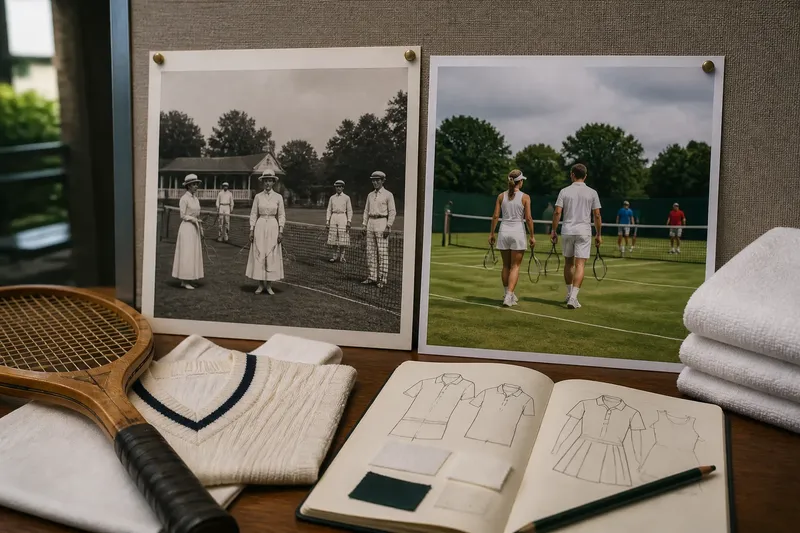
Imagine a small club preparing a display for its open day. The committee has an old photograph of players in white, a newer image in coloured kit and a blank wall beside the entrance. What it chooses to show is not a historical verdict, but a useful way to see how clothing becomes visual convention: people learn what a sport looks like by seeing the same choices repeated in familiar settings.
Tennis whites grew from the clothes of leisure
Early lawn tennis belonged to a world of organised leisure. The game was played in gardens and club grounds, where clothing reflected prevailing expectations of respectable outdoor dress as much as the physical demands of a rally. For women, that could mean long skirts and layered garments; for men, shirts, trousers and jackets suited to a social occasion. The clothes were not designed around the movement modern players take for granted.
White and other pale colours had practical and social associations. They could look cool in bright sun, and they suggested cleanliness and formality in settings where clothes were part of public presentation. Pale fabric also made sweat conspicuous, which helped it acquire a reputation for being unsuitable for visible exertion. Tennis whites grew partly from this contradiction: a garment could look composed while making the effort beneath it harder to conceal.
These choices were not universal or fixed. Clothing varied with place, class, weather and the conventions of individual clubs. Yet the early image of a player in white proved easy to recognise, and recognisability is one of the quiet engines of tradition.
Club rules turned a preference into a recognisable code
As tennis became more organised, clubs could express their identity through expectations about dress. White clothing suited the restrained appearance many institutions wanted, while a shared standard made players look like participants in the same occasion. A dress rule also drew a boundary around the club’s idea of appropriate conduct. The fabric mattered, but so did the signal: this was a managed social setting, not simply a patch of grass with a net.
Rules differed, and the details changed over time. Some clubs were strict about colour; others were more concerned with neatness or the kind of garment worn. That variation matters because the familiar image did not emerge from one universal rulebook. It was assembled from many local decisions that pointed in a similar visual direction.
Once a club’s custom was repeated in photographs, programmes and spectators’ memories, it could look older and more uniform than it really was. A house rule, copied across institutions and generations, can eventually feel like a natural feature of the sport. It is rather like the polished silver kept for a formal family meal: no one needs it to eat, but its presence tells everyone what sort of occasion they have entered.
White clothing made tennis easy to identify in public
Uniform colour gives a sport a visual shorthand. On a green lawn, white clothing stands apart from the playing surface and from the net, making the players’ movement legible to people watching from a distance. The contrast is not the whole reason for the custom, but it helped the image travel. A photograph, newsreel or illustration could communicate “tennis” with little explanation.
That shorthand became especially useful as tennis moved between private grounds and broader public attention. Images of neatly dressed players supported an idea of the sport as orderly, sociable and controlled. Those qualities were not the entire reality of play; a hard match is still a hard match. But clothing helped present a composed public face, one that connected sport to leisure and club life.
The convention also shaped what looked authentic. When viewers repeatedly saw white outfits associated with courts, coloured clothing could appear like a departure even where no rule prohibited it. Familiarity was doing some of the work that regulation did elsewhere.
How did tennis whites become part of the sport’s image?
Were tennis whites originally chosen for performance?
Not in the narrow modern sense of technical sportswear. Early tennis clothing reflected the social expectations and materials of leisure dress, with practical considerations such as warmth and sunlight mixed into the choice. The garments were not built around the unrestricted movement expected of contemporary kit.
Did every tennis club require white clothing?
No. Clubs formed their own customs, and standards could vary by institution and period. The broad image of tennis in white came from repeated similarities between those customs, not from a single rule applied everywhere.
Why does white still look traditional on a tennis court?
Photographs, tournament images and club habits have repeated the association until the colour feels like part of the sport’s visual identity. That familiarity can persist even when players wear a wider range of colours and materials.
Does wearing white make a player look more formal?
Often, because the colour carries associations with uniformity and ceremony. The effect depends on cut, fabric and setting; a loose cotton shirt and a sharply tailored outfit do not make the same impression merely because both are white.
The club display shows how tradition is edited
Back at the open-day committee, the chair suggests placing the old photograph beside the newer image. The first shows players in long, pale garments; the second shows streamlined clothing in several colours. Rather than choosing one as the “real” version, the committee adds a short caption explaining that clothing reflected both the social rules of its moment and the changing needs of play.
In this invented situation, the display gives visitors a more useful result than a single nostalgic photograph would. They can see that tennis whites were neither an eternal uniform nor a meaningless fashion: they were a convention built through local dress expectations, repeated images and a desire to present the game in a recognisable way. The choice of caption changes what the photograph seems to say.
The committee might also avoid treating the old clothing as a costume for the present. A display can honour the image without implying that players should reproduce the restrictions that shaped it. That distinction is important in a sport whose clothing has changed alongside the bodies and movements it accommodates.
Tradition can remain visible without becoming a dress rule
Today, white still works as a visual reference. A club might use it in a commemorative photograph, a programme design or a social occasion, while allowing ordinary players to choose practical clothing suited to the conditions. The reference remains legible because the convention has already done its cultural work.
For anyone reading the history of tennis whites, the useful question is not simply when players first wore white. It is how a collection of choices came to look inevitable. Look at the setting, the cut of the clothes, the club’s stated expectations and the images that were preserved. Together, those details explain why tennis whites became a public convention—and why a familiar image can outlast the rules that helped create it.